2026. 7. 12. 18:00ㆍWorld History Series (세계사 연재)
인류 역사상 한 건물에 가장 많은 지혜가 모였다가, 가장 극적으로 흩어진 사례를 꼽으라면 단연 알렉산드리아 도서관일 것입니다. 한때 이곳에는 지중해 세계 전체의 지식이 두루마리 형태로 40만 권 이상 소장되어 있었다고 전해지며, 유클리드가 기하학을 정리하고 에라토스테네스가 지구 둘레를 측정한 곳도 바로 여기였습니다. 그러나 이 위대한 지식의 전당은 결국 역사 속에서 사라졌고, 그 소실의 원인을 둘러싼 논쟁은 지금까지도 완전히 해소되지 않았습니다. 오늘 38주 차 세계사 시리즈에서는 알렉산드리아 도서관의 건립과 전성기, 그리고 소실을 둘러싼 미스터리를 프톨레마이오스 왕조의 정치적 야심과 고대 학문의 성취라는 두 축을 따라 심층 분석합니다.
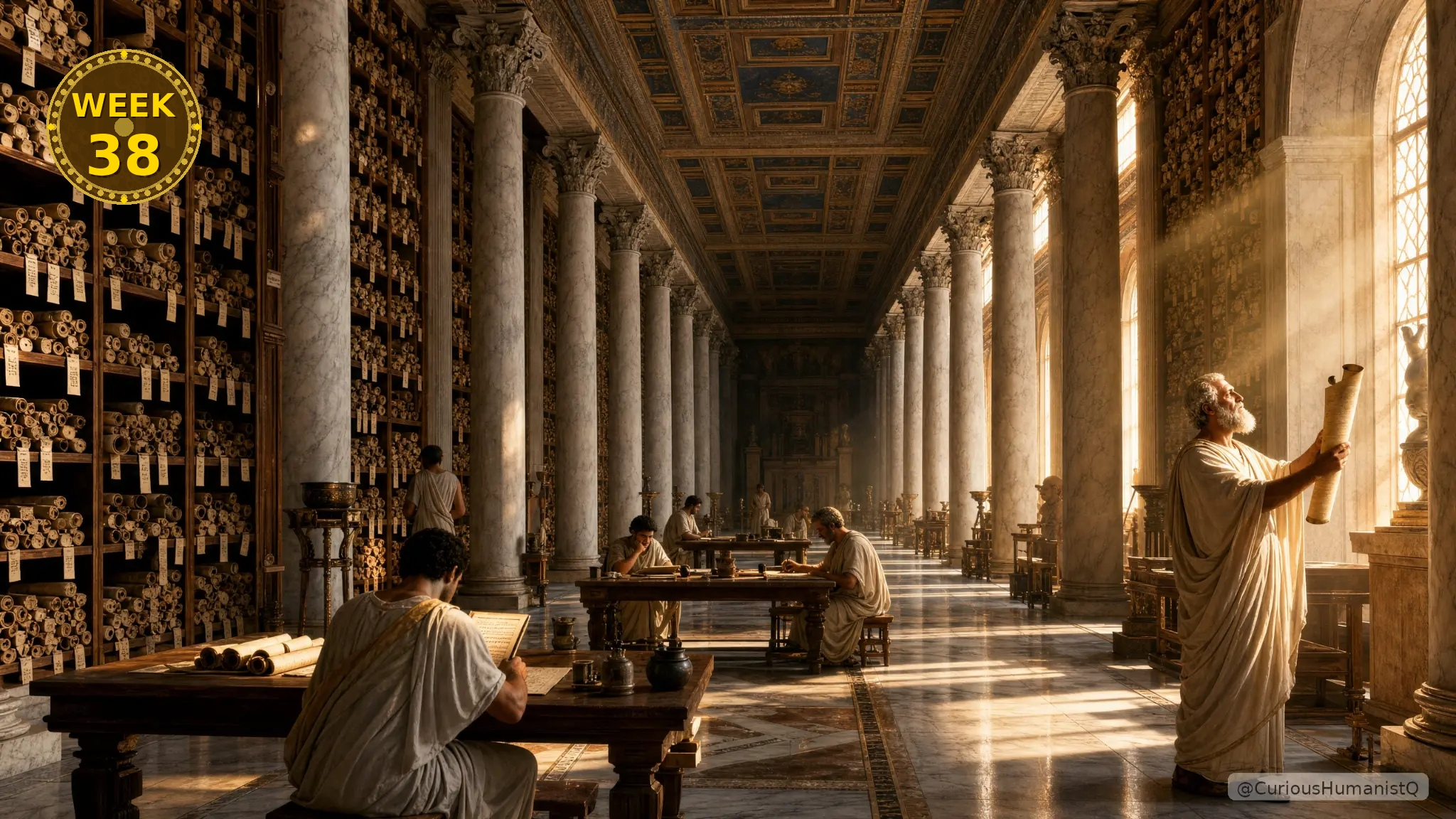
Figure 1. The Great Hall of the Library of Alexandria, c. 250 BCE : A Cinematic Reconstruction of the Principal Reading Hall of the Ptolemaic Mouseion — Photorealistic digital illustration depicting the interior of the ancient Library of Alexandria at its height, showing the Corinthian-columned reading hall, floor-to-ceiling papyrus scroll shelving (thekai) with identification tags (sillyboi), and Greek scholars engaged in reading, transcription, and textual study, illuminated by dramatic late-afternoon light through high clerestory windows. 알렉산드리아 도서관은 기원전 3세기 초, 프톨레마이오스 1세(재위 기원전 305~282년)의 구상 아래 그의 참모였던 데메트리오스(Demetrius of Phalerum)의 실무를 거쳐 프톨레마이오스 2세 필라델포스 대에 본격적으로 완성되었습니다. 도서관은 독립된 건물이 아니라 '무세이온(Mouseion)'이라 불린 왕립 학술기관의 부속시설이었으며, 이 무세이온이라는 이름에서 오늘날의 '뮤지엄(Museum)'이라는 단어가 유래했습니다. 각지의 상선이 알렉산드리아 항구에 입항할 때마다 배 안의 모든 두루마리를 압수해 필사한 뒤 사본만 돌려주었다는 일화는, 이 도서관이 단순한 수집을 넘어 지식의 독점을 국가 전략으로 삼았음을 보여줍니다. The Great Hall of the Library of Alexandria, the intellectual heart of the Hellenistic world established under the Ptolemaic dynasty in the early 3rd century BCE, housing scholars and hundreds of thousands of papyrus scrolls gathered from across the Mediterranean. The Great Hall of the Library of Alexandria at Its Height, c. 250 BCE. A cinematic reconstruction of the principal reading hall of the Mouseion (Μουσεῖον) and Library of Alexandria, the preeminent center of Hellenistic scholarship founded under Ptolemy I Soter and expanded under Ptolemy II Philadelphus. At its peak, the Library is estimated to have held between 400,000 and 700,000 papyrus scrolls (biblioi), organized in subject-classified pigeonhole shelving units (thekai) and catalogued in the Pinakes — the world's first systematic bibliographic catalogue, compiled by the poet and scholar Callimachus of Cyrene (c. 310–240 BCE). The scene depicts the characteristic activities of the Library's resident scholars: scroll consultation, transcription, and textual analysis, conducted under the patronage of the Ptolemaic dynasty in one of antiquity's most ambitious institutional projects of knowledge collection and preservation
지식 제국의 설계 : 프톨레마이오스 왕조와 무세이온
알렉산드리아 도서관을 이해하려면 먼저 그 도시 자체의 탄생을 알아야 합니다. 기원전 331년, 알렉산더 대왕은 이집트 정복 과정에서 나일강 삼각주 서쪽 끝에 자신의 이름을 딴 도시 알렉산드리아를 건설했습니다. 알렉산더 사후 그의 제국이 후계자들에 의해 분할되는 디아도코이 전쟁의 결과, 이집트는 그의 심복 장군이었던 프톨레마이오스가 차지하게 되었고, 그는 프톨레마이오스 1세 소테르로서 새로운 왕조를 열었습니다. 프톨레마이오스 1세는 군사력만으로는 헬레니즘 세계의 정통성을 확보할 수 없다고 판단했고, 알렉산드리아를 지중해 세계 최고의 학문 도시로 만들겠다는 원대한 문화 전략을 세웠습니다.
이 구상을 구체적인 제도로 완성한 인물이 아테네에서 망명해 온 정치가이자 철학자 데메트리오스였습니다. 그는 아리스토텔레스의 리케이온을 모델 삼아, 학자들이 왕실의 재정 지원을 받으며 숙식을 해결하고 오직 연구에만 몰두할 수 있는 무세이온 체제를 설계했습니다. 오늘날의 국립 연구기관이나 대학 부설 연구소와 놀랍도록 유사한 이 시스템은, 학문이 개인의 사적 활동을 넘어 국가가 후원하는 공적 사업으로 전환된 인류사 최초의 대규모 사례로 평가받습니다. 프톨레마이오스 2세 필라델포스 대에 이르러 도서관의 장서는 비약적으로 늘어났으며, 그리스어 문헌뿐 아니라 이집트, 페르시아, 유대, 인도의 문헌까지 번역해 수집하려는 시도가 이루어졌습니다. 실제로 히브리 성경을 그리스어로 옮긴 '칠십인역(Septuagint)'의 번역 작업이 시작된 곳도 바로 이 시기의 알렉산드리아였다고 전해집니다.
학문의 황금기 : 유클리드에서 에라토스테네스까지
알렉산드리아 도서관이 남긴 가장 위대한 유산은 그곳을 거쳐 간 학자들의 이름 그 자체입니다. 기하학의 아버지로 불리는 유클리드(Euclid)는 이곳에서 활동하며 《원론(Elements)》을 저술했는데, 이는 이후 2천 년 넘게 서양 수학 교육의 표준 교과서로 사용되었습니다. 아르키메데스(Archimedes) 역시 시라쿠사 출신이었지만 알렉산드리아에서 수학하며 유클리드의 후계자들과 교류했고, 부력의 원리와 지레의 법칙 등 물리학의 근간을 세웠습니다.
특히 흥미로운 인물은 도서관장을 지낸 에라토스테네스(Eratosthenes)입니다. 그는 하짓날 정오, 알렉산드리아와 시에네(오늘날의 아스완) 두 지점에서 태양 그림자의 각도 차이를 측정하는 기발한 방법으로 지구의 둘레를 계산해냈습니다. 놀랍게도 그의 계산값은 오늘날 알려진 실제 지구 둘레와 비교했을 때 오차율이 채 몇 퍼센트에 불과할 만큼 정밀했습니다. 이는 정밀한 관측 장비가 전무하던 시대에, 순수한 기하학적 사고와 체계적 관측만으로 지구라는 행성의 크기를 헤아려낸 인류 지성사의 눈부신 성취였습니다. 이 외에도 천문학자 아리스타르코스(Aristarchus)는 이미 이 시기에 지구가 아니라 태양이 우주의 중심이라는 태양중심설의 초기 형태를 제안했으며, 해부학자 헤로필로스(Herophilus)는 인체 해부를 통해 신경계와 뇌의 기능을 최초로 체계적으로 기술했습니다. 앞서 37주 차 그리스 철학의 황금기에서 살펴본 아테네의 사변적 철학 전통이 '왜'를 물었다면, 알렉산드리아의 학자들은 '어떻게 측정할 것인가'를 물으며 경험과 관찰에 기반한 실증적 학문의 지평을 열었던 셈입니다.
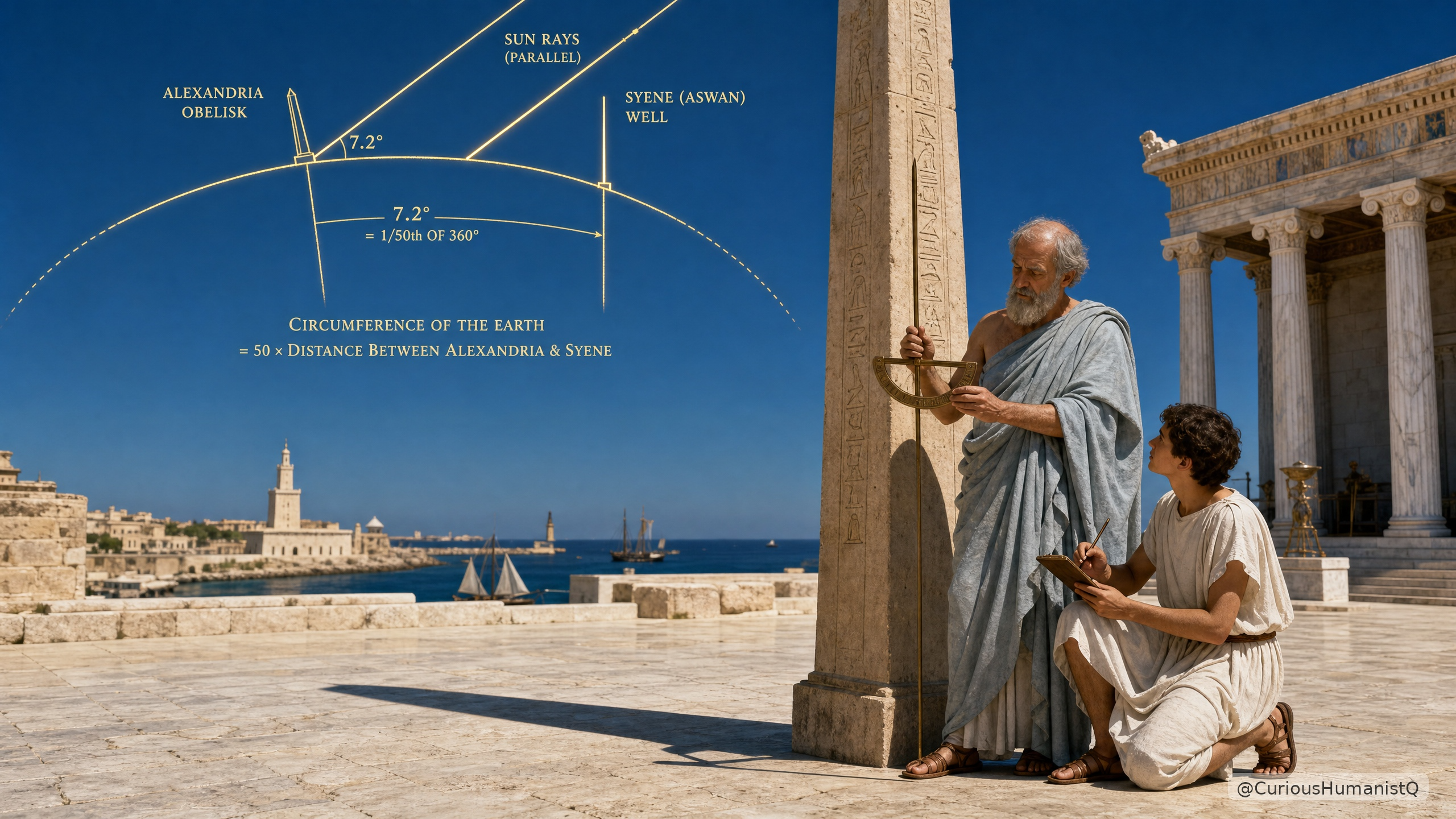
Figure 2. Eratosthenes of Cyrene Measures the Earth's Circumference Using Shadow Angle Differential Between Alexandria and Syene, c. 240 BCE — Cinematic photorealistic historical illustration depicting Eratosthenes' geodetic measurement at the summer solstice in Alexandria, with a luminous golden diagrammatic overlay illustrating the geometric principle: a 7.2° shadow angle at the Alexandria obelisk (= 1/50th of 360°) compared to zero shadow at the Syene well, yielding the calculation that the Earth's circumference equals 50 times the overland distance between the two cities 도서관장 에라토스테네스(기원전 276~194년경)는 기원전 240년경, 시에네에서는 하짓날 정오에 태양광이 우물 바닥까지 수직으로 비친다는 사실과, 같은 시각 알렉산드리아에서는 오벨리스크의 그림자가 특정 각도로 기울어진다는 관측 결과를 결합해 지구의 둘레를 계산했습니다. 이는 인류 역사상 최초로 시도된 대규모 지구 측량 실험으로 평가받습니다. Eratosthenes (c. 276–194 BCE), head librarian of Alexandria, calculating the Earth's circumference through simultaneous shadow-angle observations at Alexandria and Syene — one of the earliest recorded large-scale scientific measurements in human history. Eratosthenes Measures the Circumference of the Earth, Alexandria, c. 240 BCE. The chief librarian of the Library of Alexandria and polymath Eratosthenes of Cyrene (c. 276–194 BCE) is depicted conducting his celebrated geodetic measurement at the summer solstice, using the differential shadow angle cast by an obelisk in Alexandria compared to the known absence of shadow at the well of Syene (modern Aswan) at solar noon. By observing that the shadow angle at Alexandria measured approximately 7.2° — or 1/50th of a full circle (360°) — and multiplying the known overland distance between the two cities by 50, Eratosthenes calculated the Earth's circumference to be approximately 39,375–46,620 km, a result remarkably close to the modern accepted value of 40,075 km. The golden diagrammatic overlay in the upper left visually encodes the geometric logic of the method. The Pharos Lighthouse of Alexandria is visible in the background harbor. Cinematic photorealistic digital illustration with scientific diagram overlay
사라진 지식의 미스터리 : 도서관은 어떻게 소실되었는가
알렉산드리아 도서관의 소실은 단 한 번의 극적인 화재가 아니라, 수 세기에 걸친 점진적 쇠퇴와 여러 차례의 파괴가 중첩된 결과였습니다. 흔히 대중적으로 가장 널리 알려진 이야기는 기원전 48년, 율리우스 카이사르가 알렉산드리아 내전에 개입하는 과정에서 항구에 정박한 함선에 불을 질렀고, 그 불길이 항구 근처 창고까지 번지며 도서관의 일부 장서가 소실되었다는 설입니다. 로마의 역사가 플루타르코스(Plutarch)를 비롯한 여러 고대 문헌이 이 화재를 언급하지만, 학자들 사이에서는 이때 소실된 것이 도서관 본체가 아니라 항구 근처의 별도 창고에 보관되던 일부 두루마리였을 가능성이 높다는 견해가 우세합니다.
두 번째 결정적 사건은 서기 391년, 로마 제국이 기독교를 국교로 삼은 이후 발생했습니다. 당시 알렉산드리아 대주교 테오필루스(Theophilus)의 주도 아래, 이교 신앙의 상징이던 세라페움(Serapeum) 신전이 파괴되었는데, 상당수 학자들은 도서관의 후신에 해당하는 장서들이 이 신전 부속 도서관에 함께 보관되어 있었을 것으로 추정합니다. 세 번째로 널리 퍼진 이야기는 서기 642년 무슬림 군대가 알렉산드리아를 정복했을 때 칼리프 우마르의 명령으로 도서관이 최종적으로 불태워졌다는 설인데, 이 일화는 사건 발생 후 수백 년이 지난 13세기 문헌에서야 등장하며 동시대 사료의 뒷받침이 전혀 없어 오늘날 대다수 역사학자들은 이를 후대에 만들어진 정치적 프로파간다로 간주합니다. 결국 알렉산드리아 도서관의 소실은 특정 종교나 특정 정복자의 단독 범행이라기보다, 로마 제국 후기의 재정 축소와 반복된 정치적 혼란 속에서 학자 공동체가 서서히 흩어지고 필사와 보존을 위한 재정 지원이 끊기면서 나타난 장기간의 문화적 쇠퇴로 이해하는 것이 오늘날 학계의 중론에 가깝습니다.
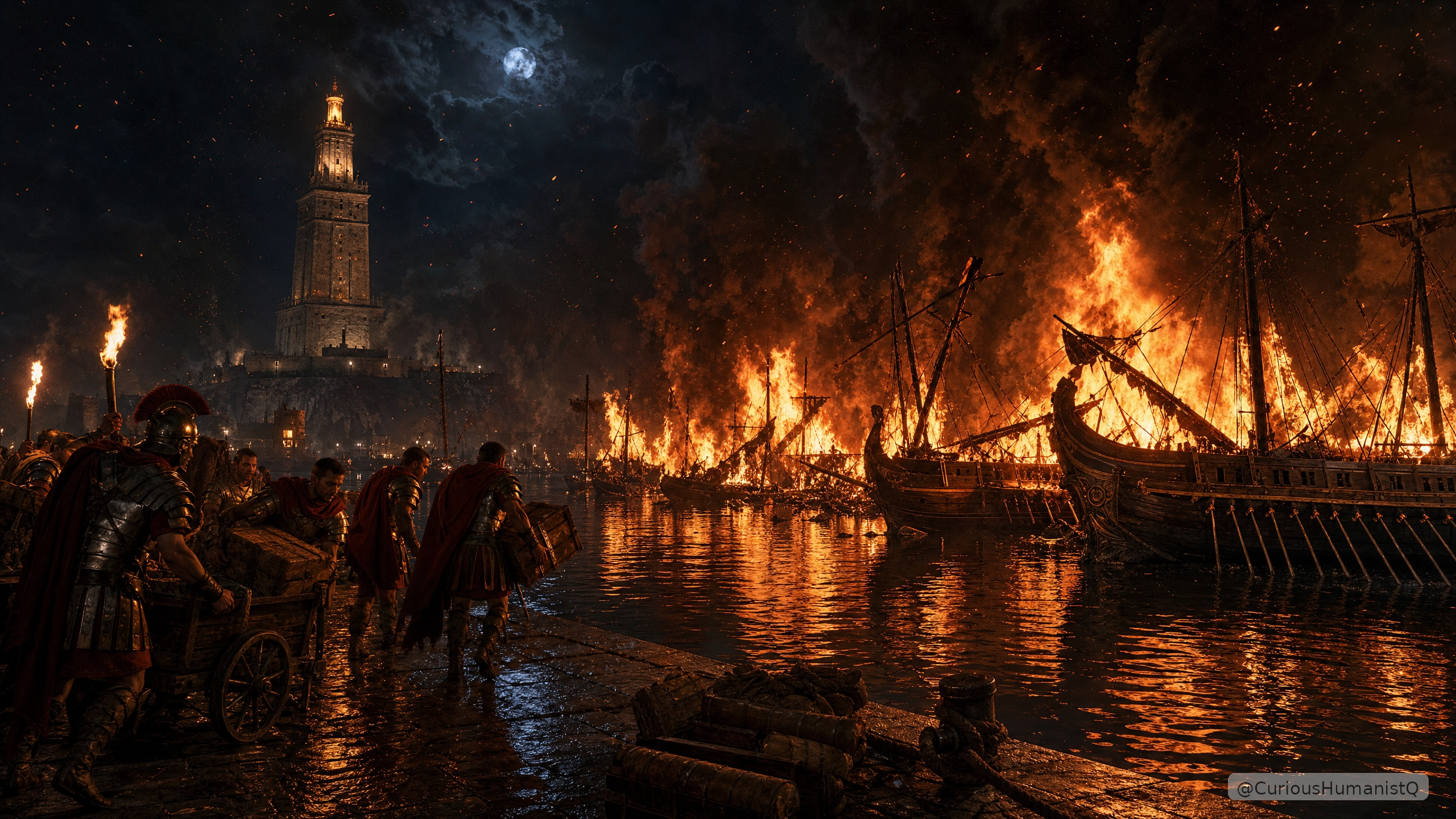
Figure 3. The Alexandrian Harbor Fire of 48 BCE : Caesar's Forces and the Burning of the Ptolemaic Fleet During the Bellum Alexandrinum — Cinematic photorealistic historical illustration depicting the nighttime harbor fire set by Julius Caesar's forces during the Alexandrian War, showing Roman soldiers evacuating cargo from the burning docks while Ptolemaic warships are engulfed in flames, with the Pharos Lighthouse standing in calm contrast in the background — an event historically associated in ancient sources with collateral damage to scroll collections stored near the harbor, and long debated in connection with the destruction of the Library of Alexandria 기원전 48년 알렉산드리아 내전 당시 카이사르가 자신의 함선에 불을 지른 사건은 도서관 소실 논쟁의 출발점이 되었습니다. 그러나 현대 역사학은 이 화재가 도서관 본체를 완전히 파괴했다기보다, 이후 수 세기에 걸친 정치적 격변과 재정 지원 축소가 겹쳐 학술 공동체 전체가 서서히 해체된 장기적 쇠퇴 과정의 상징적 시작점이었다고 평가합니다. The fire at the harbor of Alexandria during Caesar's civil war intervention in 48 BCE, traditionally cited as the first blow to the Library of Alexandria, though modern scholarship views the library's ultimate disappearance as a centuries-long process of political upheaval and declining institutional support rather than a single catastrophic event. The Burning of the Alexandrian Fleet, Harbor of Alexandria, 48 BCE. During Julius Caesar's Alexandrian War (Bellum Alexandrinum, 48–47 BCE), Caesar's outnumbered Roman forces set fire to the Ptolemaic fleet moored in the Great Harbor of Alexandria to prevent its use against them, an act that ancient sources — most notably Plutarch, Strabo, and Seneca — associate with the accidental spread of fire to the adjacent harbor warehouses (apothecai) and, by some accounts, to portions of the Library's book collections stored near the docks. The historical extent of this fire's damage to the Library of Alexandria remains a subject of scholarly debate; most modern historians conclude that the Library itself was not destroyed at this time, but that significant scroll collections stored in harbor warehouses were lost. The Pharos Lighthouse, one of the Seven Wonders of the Ancient World, is visible in the background, its beacon fire burning steadily above the chaos
잿더미 너머의 유산 : 왜 우리는 여전히 알렉산드리아를 기억하는가
알렉산드리아 도서관이 실제로 소장했던 두루마리 중 오늘날까지 물리적으로 전해지는 것은 사실상 전무합니다. 그럼에도 이 도서관이 인류 지성사에 남긴 유산은 결코 사라지지 않았습니다. 유클리드의 기하학 체계는 오늘날까지도 중고등학교 수학 교육의 뼈대를 이루고 있으며, 에라토스테네스의 측량 방법론은 현대 측지학(geodesy)의 원형으로 평가받습니다. 무엇보다 알렉산드리아 도서관이 남긴 가장 중요한 유산은 개별 발견이 아니라 하나의 '이념' 그 자체였습니다. 즉 인류의 모든 지식을 한곳에 체계적으로 모으고, 국가가 이를 재정적으로 후원하며, 서로 다른 문명의 지적 전통을 번역을 통해 통합하려 했던 이 시도는, 오늘날의 국립도서관ㆍ대학ㆍ백과사전ㆍ디지털 아카이브에 이르기까지 지식 축적 제도 전반의 이념적 조상이라 할 수 있습니다.
현대에 이르러 이집트 정부와 유네스코는 1974년부터 논의를 시작해 2002년, 옛 도서관이 있던 자리 인근에 '비블리오테카 알렉산드리나(Bibliotheca Alexandrina)'라는 현대식 도서관을 재건했습니다. 이는 단순한 관광지 복원이 아니라, 지식이 특정 종교나 국가에 귀속되지 않고 인류 공동의 자산으로 보존되어야 한다는 고대 알렉산드리아의 이상을 21세기에 되살리려는 상징적 시도입니다. 결국 알렉산드리아 도서관의 진짜 역사는 화재로 끝난 것이 아니라, 그 이념이 형태를 바꾸어 지금 이 순간에도 계속되고 있는 살아있는 프로젝트라 할 수 있습니다.
📌 함께 읽으면 좋은 세계사 통찰
- [WEEK 37] 그리스 철학의 황금기 — 소크라테스, 플라톤, 아리스토텔레스
- [WEEK 36] 디아도코이 전쟁 — 알렉산더 사후 제국의 분열과 후계자들의 투쟁
- [WEEK 35] 헬레니즘의 개막과 문화적 융합 — 알렉산더가 남긴 세계시민주의의 유산
- [전체 목록] 52주로 완성하는 세계사 흐름 총정리
📚 References (참고 문헌)
— 1차 사료 (Primary Sources)
- Plutarch. Life of Caesar — 기원전 48년 알렉산드리아 화재 관련 기록.
- Strabo. Geographica, Book 17 — 알렉산드리아 무세이온과 도서관의 구조 묘사.
- Ammianus Marcellinus. Res Gestae — 세라페움과 도서관 부속시설 관련 기록.
- Orosius, Paulus. Historiae Adversus Paganos — 후대 도서관 소실 관련 서술.
— 2차 사료 (Secondary Sources)
- MacLeod, R. (Ed.) (2000). The Library of Alexandria: Centre of Learning in the Ancient World. I.B. Tauris.
- El-Abbadi, M. (1990). The Life and Fate of the Ancient Library of Alexandria. UNESCO.
- Canfora, L. (1989). The Vanished Library: A Wonder of the Ancient World. University of California Press.
- 남경태 (2011). 《종횡무진 서양사》. 휴머니스트.
- 김덕수 (2016). 《그리스와 로마: 지중해의 여명》. 살림.
Epic History & Strategic Archive
본 포스팅은 거대한 문명의 충돌과 전쟁의 역사를 전략적·인문학적 관점에서 재구성한 호기심 인문학자 Q(Curious Humanist Q)의 고유 저작물입니다.
인류의 운명을 바꾼 결정적 순간들을 기록하는 이 아카이브의 무단 전재 및 상업적 활용을 금하며, 인용 시 반드시 출처를 명확히 밝혀주시기 바랍니다.
ⓒ 2026. 호기심 인문학자 Q(Curious Humanist Q) All Rights Reserved.
'World History Series (세계사 연재)' 카테고리의 다른 글
| [WEEK 37] 그리스 철학의 황금기 : 소크라테스, 플라톤, 아리스토텔레스 (1) | 2026.06.28 |
|---|---|
| [WEEK 36] 디아도코이 전쟁 : 제국의 분열과 후계자들의 투쟁 (2) | 2026.06.21 |
| [WEEK 35] 헬레니즘 시대의 개막 : 동서 문명의 거대한 융합과 알렉산더의 유산 (2) | 2026.06.14 |
| [WEEK 34] 알렉산더 대왕의 동방 원정 : 페르시아를 무너뜨린 전략과 헬레니즘의 서막 (1) | 2026.06.07 |
| [WEEK 33] 알렉산더와 마케도니아 : 제국의 부상과 불가능을 향한 진격 (1) | 2026.05.31 |